I've decided, dear readers, that since you've been so tolerant of my delays between posts, I would share a sneak peek of the work I've been doing on the book I mentioned. The text and picture are both rough drafts from the book, in a section about forts. This particular fort is called the Pallet Palace. I'd love to hear any feedback you have, since this is a rough draft. Follow the break to read the page. Thanks for sticking with me, Readers!
Showing posts with label creativity. Show all posts
Showing posts with label creativity. Show all posts
Saturday, June 16, 2012


Thursday, May 17, 2012
My Latest Project (or, excuses excuses...)
Hello readers, I know that you had probably given up on seeing any updates from this blog, but it's not true! I've been very distracted lately, and haven't felt that I had much to say to you, so rather than pester you with filler, I decided to let it go for awhile. I admit, after this post, I may go silent for another while. However, let me fill you in on what is currently taking up my time!
So, you may not have heard of lulu.com, but it is a self-publishing website. I had an idea for a book a few months ago, and have finally decided to get my butt into gear and start writing. The title of the book is The Expert's Guide To Getting Into (And Sometimes Out Of) TROUBLE I know, it's a long winded title, but I like it. Anyway, it's a book about projects for kids, from building treehouses to fun pranks to pull, to stories to tell younger siblings to torment them for years. It's basically a guide to all of the things that kids used to do when it was okay to climb trees and skin knees.
For now, that's all I can really tell you, but I have already wrapped out about twenty pages (sans illustrations) and wanted to let you know that I am not dead, but rather, happily busy. Look for more updates on the book as I get closer to publishing, and thank you for being supportive!
 |
| An exploded view of the doghouse project from the book! |
Friday, February 3, 2012
Hangout Games Pt. 2
Okay, where were we? That's right, my next step was explaining the builder portion of this game.
Basically, the builder is a simple tile-based system. The creator chooses a size level at the beginning, and from there they are asked to choose an element/theme. This determines the tileset and sprites the creator will be able to use, such as volcanic mine, or dreary forest. There would be a large array of tilesets, and the library would be constantly expanding. The tiles aren't different physically, that is, a wall is still a wall, a rock is a rock, floors are floors, etc. Mostly, the difference is aesthetic. However, there would likely be elements from each them that would be unique, such as cart rails in the aforementioned mines, or foliage overhead in a forest. Every element would be able to be painted onto the map, and the edges would automatically align. So, when a player draws a pool of water, lava or acid (as examples) the edges of that pool would create their own shores. So, the player draws all the elements of their map, including multiple floors, stairs, walls, decorations, raised walkways, and bodies of water. Then the player moves to the puzzle layer of the editor.
This layer takes care of the elements that adventurers interact with using the action button. The creator is given a palette of objects such as doors, switches and pushable blocks. Each of these behave in specific ways, and are aesthetically adapted to the them of the map.
First of all, doors. Doors are pretty obvious, so I'll pair them with locks for simplicity. Whenever a player paints a door, lock, or locked treasure chest, they are immediately prompted to place a key for that object. The creators will be given the option to ignore the notice, if they need to, but will not be able to test or publish their dungeon without placing keys for every lock. They may place a key in a chest, in the open, as the solution to a puzzle, or even into the pocket of a monster (I'm getting there, I promise.) There may also be theme-specific components that they may place keys, like a minecart, for example, or the belly of some sort of machine.
The second element of the Puzzle layer is the puzzles themselves. These are more complicated, if only because there are so many different types of them. In the editor, when the creator decides to place a puzzle, they must first select the obstacle that the puzzle removes. This could override a lock on a door, for example, or even walls. If the creator decides that their puzzle opens a secret passage through a wall, for example, they would draw a brightly colored indicator over which wall pieces would disappear when the puzzle is completed. If, on the other hand, the puzzle say, lifted a bridge from a pool of acid, they would first draw the bridge and then place the indicators over it. Then, after placing the indicators, they would be asked which state is natural, is the bridge there before the puzzle, or does is appear?
Then they may begin building the puzzle itself, using switches and blocks, lasers, and who knows what all else. one of the tricks is that every switch has a series of options. It's a bit complicated to explain, but in a right-click window (as it would appear in-designer) the options would be simple. the creator would choose which puzzle the switch operates, they would choose which direction it works, (for example, pressing one switch might undo others) and they can decide if the switch must be held down for it's effect to remain. The switches can also be linked to specific indicator colors, so that when say, a player presses one switch, maybe a door opens, but the floor leading to it becomes covered in spikes, so that only a certain combination of switches will create the access the players need. Switches can also be triggered in such a way that multiple switches must be triggered at once to activate them. That would cause players to have to cooperate to solve puzzles. eventually, when the creator has satisfied their puzzle building needs, they can test-play it to make sure all puzzles are solvable. In the test-play mode, they are given "dolls" which they can leave on a switch as a person, so as to test multi-person puzzles.
This layer also includes story-related events, including events triggered by being in a location, or conversations with npc's. these are created in almost exactly the same way as puzzles, using triggers and actions.
Then, the creator moves on to the final layer of the editor; monsters.Every style of dungeon has it's own types of monsters that are location-specific. For example swamp-plants in a marsh, or goblin machinists in a factory. However, there are classic monsters that can be called on as well, spiders, lizard-men, slimes, etc. These can be placed one at a time onto the map, using a brush tool. they can be grouped into teams, so that they wear color-coded clothes/accents and work cooperatively (obviously not all enemies can work together, since swamp plants are likely to operate on instinct). some enemies would come with objects rthat can be placed with them, for example, a Kobold machine-gunner would likely come with sandbags, and the Kobold might even be placed away from his den, to create a race-against the clock element. Another example (and a much more obvious one I should have thought of first) is spider webbing.
Finally, the player creates a boss fight for the dungeon. The boss fight is created in a separate sort of editor, still part of the main one, but brought up in a new window. In this window, there is a viewing screen, where they can view their boss as it acts through its animations and attacks. Underneath that frame is the editor for it. First, the creator chooses from many sprites of enemy, and even types (Small fighter, classic serpent dodging around the room, giant stationary monster, giant walking monster, etc.) Then after selecting an enemy, and coloring it appropriately, they are given a timeline for it's actions. The timeline is based on hitpoints. For example, if the villain starts with 100 hp, the first portion of timeline could be from 100-75 hp. During that time in the boss' life, they would perform a certain type and number of attacks in a certain order, and move in a specific way. Then, after the hero has done 25 hp of damage, the monster would move into say, it's 75-50 range, where it would perform different attacks and movements. The boss' hp could be divided many times, creating a complex creature. Then the player could introduce Dialogue for the villain, and choose a loot category for it, determining the type of treasure that the villain can drop. In certain sized dungeons, specifically large ones, the creator would be allowed to insert a mini-boss partway through, using the same editor.
The creator is also able to use pre-built rooms and enemies, which they could drop into place like tiles.
The last and most important element of this designer (I know, I know, too long, didn't read) is the grading scale. After the creator has finished editing, the click "Publish" They will be prompted for a name, and a description, and given the option to include the dungeon into a quest. Then, the computer takes over. The computer would review the map, looking at things like the number of switches used to trigger puzzles, the total HP of enemies, the level of enemies, and the size of the map, and create a star rating for the difficulty of the map. This is crucial because if the maps aren't ranked appropriately, new players may find themselves trapped in a dungeon that is too powerful, and end up having no fun at all, which is the most important part of any game. However, the difficulty grading does more than that. It allows the designer to create escalation in a campaign, and also determines the quality of items inside of the dungeon. More difficult dungeons obviously earn players more powerful armor, weapons and treasures. Players can also upvote maps after having completed them, and provide reviews, which can also effect the overall rating of the map. The entire game is about creating a social experience that causes players to work together, either in a dungeon, or on a dungeon.
Hopefully you managed to get through all that, I didn't realize I had spent so much time thinking about it between my last post and this one, but apparently, there was a lot going on in the back of my head. Anyway, I'd love to hear anyone's thoughts on this or any of the designs I've posted, so feel free to comment! Thanks for reading!
P.s. If you decided to create this game, PLEASE let me know, and please give me credit for the original concept. If someone does make it, I'll do my very best to help you publicize, and I'd even be willing to collaborate, if needed. Thanks!
Wednesday, January 11, 2012
Hangout games pt. 1
So, It's been awhile, but I did promise you at least three game ideas, so here, dearest readers, is number three.
A lot of people have heard of Google Plus, and may be familiar with one of its big components, hangouts. However, for those of you who are unfamiliar, let me sum it up. Hangouts is a chatroom with video for up to ten people to video chat on, with adaptive screen scaling, and a developer component called Hangouts with add-ons. That's the part that matters here, because it allows web developers to make apps for hangouts. The idea behind my game is to create an add-on that serves as a full blown game, using hangouts to play. My idea is a dungeon crawler, in the fashion of diablo, where the players co-operate to battle through the dungeon, and must solve puzzles in collaboration. The game uses simple action mechanics, walk, fight, and push, like an oldschool adventure game. Think Legend of Zelda: Link to the Past, as far as mechanics, but with ten players running around at the same time. Obviously, It's a lot for developers to work on, because to develop puzzles for that size group, there's a lot of thought involved.
That's why the second half of the game is based around building. On a website separate from the played game, players will be invited to create dungeons. The computer will assess the difficulty of the puzzles, as well as the enemies, and pay the player for their maps in in-game gold.
I'll focus more on the dungeon builder in my next post, but I wanted to give you a taste of it.
As far as plot goes, I actually imagine this game as fairly classic. It's an adventure game set in a somewhat steam-powered fantasy world. Swords and sorcery and steam, if you will. There are five types of class: Fighter, Healer, Mage, Thief, and for lack of a better term, a red mage. The fighter, obviously is geared toward combat, healer toward healing, and mage toward magic. The thief has abilities more geared toward status effects, stealing and light damage, while the red mage is a fair balance between magic and fighting. Each character has two assignable attack slots, one for left click, and one for spacebar. The left click would be especially suited for things like arrows, throwing knives, or spells, which would be aim-able via the mouse. While the spacebar would be good for short-range attacks. However, when the player is standing next to a chest, door, person or switch, the spacebar would become the "Action button" allowing them to acivate those things, or to speak to a person. Movement would be controlled by WASD.
I think that most of the plot would be devoted to being roving adventurers, saving princesses, defeating monsters and saving villages. However, through the building system, some dungeons could be linked together into campaigns, with full-blown story archs. It would allow people who are drawn to the dungeons and dragons to create a full story for their friends to play, without having to worry about managing dice rolls and mechanics, since the game will handle all of that already. Players could even divide the task of dungeon building in an arch, so that no player knows all of the dungeons, and everyone could play together.
As I said earlier, I'll get into dungeon building in my next post. Hopefully you enjoy the concept so far, I have a lot of Ideas for this game, and would love to work with a team to create it.
P.s. If you decided to create this game, please let me know, and please give me credit for the original concept. If someone does make it, I'll do my very best to help you publicize, and I'd even be willing to collaborate, if needed. Thanks!
Wednesday, December 28, 2011
Invasion
So, as promised, here's another idea for a game.
This one takes advantage of the wii platform, but could also work on the xbox Kinect, or the ps3's new motion control system. It's a formula that has been used on the wii already, but not to good effect.
Basically, the game is a rail shooter, in the style of Time Crisis, but with several improvements on the formula, and particularly improvements on what (I believe) the wii has seen so far in the genre.
First of all, let me roll into atmosphere, the flavor of it. Not because it's the most important aspect, certainly, but because the flavor makes the other elements seem more tangible. The game is set in a science-fiction universe. It's a mildly playful style, bright and colorful. The story starts in a liquor store, where the hero is working as a clerk. Large booming sounds reverberate outside, a low rumble fills the sky, and shadows creep across the street. The hero steps out from behind the counter, and dashes into the street, in time to see an alien spacecraft filling the skies. In a rush, pods smash into the ground, and burst open, with alien marines dashing out and instantly vaporizing several nearby humans. The hero runs backward into the liquor store, and crawls under the counter, where a pistol is laying next to the alarm button. The hero grabs the pistol, just as one of the aliens enters the liquor store. In six shots, the alien is dead, and the hero is out of bullets. The alien has dropped a gun, however, and the hero runs to pick it up. The hero goes into the streets and battles through aliens and machines and the chaos of humans in terror to make it home to their family.
So, hopefully, that flavor enticed you enough to listen to some mechanical talk. Anyway, here's the deal: the problem with rail shooters is that they are essentially the same thing as shooting gallery games. Normally, it is a short sequence of running, during which you have no control, followed by a short section of shooting, then your character runs again. Here's a key difference for the shooter I am proposing bears several differences, primarily in that structure there. The player is given much more control over their character, using the nunchuck. Firstly, the hero is in control of hiding behind cover. Holding the Z button raises the hero up from behind cover. Moving behind cover automatically reloads the hero's gun. There are two other buttons on the nunchuck that come into play: firstly, the c-button, which is used to change weapons. The key to that is that to press the c button more or less requires you to release Z, moving you into cover, which is the only place you can change weapons. The other button on the nunchuck that matters is the analogue stick. Rail shooters always lock the player into one single line of sight: forward. The analogue stick is used to turn the hero's field of view, a total of ninety degrees in all directions, and when the stick is released, it moves to a neutral center. What it means is that the player feels more in control of their play, and the gameplay becomes more immersive.The player can also move their camera and shoot during all of the moving portions. They are playing at all times, which is important. It helps blur the line between rail shooter and first-person-shooter. A lot of players hesitate to play rail-shooters because they feel that the experience is lacking compared to a first-person-shooter because of the difference between movement, and the length of time waiting for action to resume.
At the beginning of each chapter, the player is given the option of choosing their load-out for the trip. They will always have the pistol they stole from the first alien, which does not run out of ammo. They will also have two slots for other guns. The hero can gather more guns as they fight through their adventure, sometimes by shooting certain enemies, sometimes by finding them behind cover, and other things like that.
One last thing that is missing from rail shooters is the feeling of choice. Fortunately, the mechanics I'm suggesting make it possible to split the track that the player is on. When the hero is in a running portion, occasionally two arrows will flash on screen, suggesting two paths. The player will use the analogue stick to choose a path, and the story will go in that direction. There may also be instances where the arrows will not flash on screen, but holding the stick during a run will change paths anyway, allowing for secrets.
I think I could write more on this game, actually, but for now, it is 2:24 at night, and I am incredibly sleepy. If you are interested in hearing more, let me know in the comments!
P.s. If you decided to create this game, please let me know, and please give me credit for the original concept. If someone does make it, I'll do my very best to help you publicize, and I'd even be willing to collaborate, if needed. Thanks!
Wednesday, December 21, 2011
The ghost's castle
So, I spend a lot of time thinking about games, and about game design. Maybe you've noticed. Anyway I've decided that since I never seem to have the time to actually execute any games, and haven't really had time to create anything playable (after all, I barely take the time to update this blog) I've decided to share some ideas for games and see if the ideas get picked up by anyone with the time and knack. So, here we go!
The first concept is an exploration-based adventure game. The protagonist has been kidnapped by otherworldlies, say fairies, or spirits, and dropped into an old castle, drifting in and endless space, to teach the hero a lesson about his/her life. The castle is vast, with gardens, towers, grand halls, and a multitude of varied rooms. Many, maybe most of these rooms, are empty when the hero first enters them. But, after solving a few puzzles in some of the fuller rooms, the hero finds the first of several masks. The masks resemble people from his life, possibly through one characteristic, definitely not through facial emulation, because that's creepy. Anyway, The hero finds the mask, and puts it on, and in doing so, the castle changes before them. Suddenly, rooms that were empty are furnished, there are more puzzles to solve, and from time to time, people pass through the halls.
The hero tries to address the people in the halls, but the figures just carry out their actions. They act out scenes from the hero's life, moments of regret, choices made, etc. They are all dressed in fancy clothing, ball gowns, suits, and masks, as if they are all attending a masquerade, which they are. All of the figures are fairies, or spirits, playing their part in the heroes' past. As the hero progresses through the flashbacks and puzzles, he or she eventually finds another mask, which reveals a different set of full rooms, events and the like. The hero eventually finds a total of say, seven masks. Each one reveals a different set of rooms and puzzles, and helps the hero understand their mistakes, and eventually, to come to understand what they must do to set things right.
The important thing about the masks is that they don't change the castle, they just reveal what is there. From the very start, just about all rooms are accessible, only one or two doors are ever locked, and they are unlockable by things hidden by the masks.
Now, I just realized that I had planned on spouting out about three games in this one post, but since I ended up writing a whole big chunk about that one idea, I've decided to break this up into a few different posts. So, expect the second in a week or so.
P.s. If you decided to create this game, please let me know, and please give me credit for the original concept. If someone does make it, I'll do my very best to help you publicize, and I'd even be willing to collaborate, if needed. Thanks!
Monday, October 31, 2011
The Haunt: Finale!
 Okay, dear readers, the Haunted Library is finally over! So, as promised, I'm doing one more post about it, looking back on what I would (and likely will) do differently next year. Now, you may have heard the phrase "pics, or it didn't happen," as it turns out, none of us remembered this, so we have no proof that we ever performed this haunt. I have a few phone pictures of a few props being built, which I will put on a page HERE with the maze, but without pictures of everything installed in the library, I'll excuse your skepticism. As for the video I mentioned, It exists, but is really just five minutes of black with occasional flickers of faces and light. it's pretty lousy, so I've decided not to put it up.
Now for the good news. On Friday, we put the haunted house up starting at about ten am, and finishing at about 5:10 pm. With a total of four actors in the haunt, we managed to scare the daylights out of a total of 378 guests, and earned as many dollars for the library to buy books with! Or, in other words, the Haunt was a huge success! While we didn't manage to get everything working that we wanted to, we put together enough of a haunt that people were going through more than once, and had a fantastic time.
Monday, October 24, 2011
Room #5: The Pumpkin Patch
As the Guests exit the forest, they make a hard left turn into the pumpkin patch, but not before a Giant's Shadow pounces across a wall to their right, standing ten feet tall, and chasing them into the pumpkin patch.
First, the guests pass through a gate, fashioned to look like a large jack-o-lantern, and as they walk through it's mouth, they find themselves in a graveyard, overgrown with pumpkins. There's a stone wall running along one side, with small pumpkins resting on top. And a scarecrow waits at the end of the path with a bowl of candy for the guests.
This room, obviously, is where the giant pumpkin from my earlier post will be living, with a giant candle inside of it. all made out of cardboard. This room is much brighter and more playful than the others, mostly orange and green throughout the room.
The scarecrow will be an actor, who can decide to scare children if he wants to. The biggest isssue of this room is building pumpkins. See, with our budget of approximately $1, buying a bunch of pumpkins and carving them into jack-o-lanterns is out of the question. So, we've made a few pumpkins in three dimensions out of cardboard,and we're in the process of creating a few groups of pumpkins in two-dimensions. The tombstones are made out of foam I already had, and have cut into stones.
It's a simple room, with a lot of building to create a well-dressed scene. A lot of this has to be built in the space, which makes this room a bit of a challenge, since we have about four hours (Hopefully we'll get more time) in the space to set up.
Now that I've filled you in on how everything should look, I'll be filling you in on how some of it is being built, and hopefully, I'll end with a video walk-through on Saturday.
Friday, October 21, 2011
Room #4: The Forest.
Okay, readers, let me level with you, this post took so long to get to you because two days ago, I almost changed this room. Let me tell you why. This room is a big u-turn shape designed to look like a haunted forest. A large group of trees encircle the guests, and arch their branches high overhead, where an owl looms, and several crows grumble, caw, and crack-wise. Meanwhile, guests are hit with a mysterious gust of wind, and something lurks just beyond the trees.
As you can see on the MAP the forest is one of the larger areas in the haunt. The downside of that is, that room will require a lot of scenery, and I honestly (still) have concerns about us getting enough trees in there to make it spooky. Originally, we were going to make the trees out of butcher paper, and create faces on them, like the trees from the "Wizard of Oz". Here's the issue with that: Each of those trees would need some sort of solid structure running from toe to tip, and to be honest, I'm on too tight of a budget to purchase lumber to brace the insides. So, I decided to cut the entire scene from the haunt, and asked my family for other suggestions. Then my old man decided that he had found the plan to build the forest, and help himself out as well, the old coot. So, we tore down old branches from our mulberry tree in the back yard, and he's taken it on himself to turn those branches into trees. Hopefully, he knows what he's doing.
Meanwhile, I've got to make sure that the rest of this forest is spooky!
There will be at least one person in the forest to do some old-fashioned scaring, and to try some other tricks as well. Firstly, I've modified an Airzooka to sit on a solid base, and be fired remotely with a cord. Which means I can hide the airzooka in a bush somewhere, and not let guests know where the gust of wind has come from.
Meanwhile, overhead, a pair of crows are sitting in some branches, cawing and making a few jokes. It's a simple matter of a couple of cardboard silhouettes and some decent sound design, which is being handled by y brother.
Then, they turn the corner, under a spooky moon and and actor either lurks in the forest, or leaps out at the guests, depending on the age and bravado of the guests. In all likelihood, this is probably me in a simple costume. Then, they turn one last corner into the last room of the haunt.
Monday, October 17, 2011
Room # 3: The Cave
 |
| Not a photograph of MY cave, but how cool would that be, right? |
Actually, both of these are pretty classic haunted house tricks. The first portion of the cave uses darkness to convince the guests that something more is happening, when really, they're walking on a bit of bubble wrap, and string is tickling their face. Classic.
The Second Chamber of the cavern is a mysterious room filled with mirrors. the room will have four mirrors arranged in an array, lit only with blacklight. On each mirror will be a different ghost, which glows under the blacklight. Everything in the room will be covered in heavy cobwebs, hinting at what's to come.
The inside of the cave itself will mostly be black plastic, forming an uncomfortably low ceiling. Kids will be fine, but parents my have to duck, creating discomfort. I know that sounds like a bad thing, but creating unpleasant atmosphere is half of what a haunted house is about. A building full of people jumping out is startling, but it isn't scary. To create fear, there needs to be buildup, and claustrophobia is a simple fear to play off of.
The third chamber of the cavern is through a black curtain. the ceiling opens up here, but only to make room for a giant black widow, standing across the top of the pathway! The spider stands above the guests, rocking back and forth above their heads, as it's children hang from the walls.
The spider itself is going to be made primarily from chicken wire on a frame,, and wrapped with paper mache. (my goodness, I am using so much paper mache!) The real trick of the spider is that the guests are walking at that time between two bookshelves that are already in the library. Each bookcase is about four feet high, and will serve as a resting place for four of the spider's legs, so that the spider stands directly above the path. The lurching motion of the spider is created by a modification of the "Flying Crank Ghost". This link doesn't go to a how-to, unfortunately, they're harder to find than I remember. Leave A comment If you'd like a more in-depth explanation, and I'll write a post about it
I'm using the same mechanism, but modifying it to use only two points, and rocking the body back and forth. I may also attach the spider's front two legs to the crank, to add more motion to the scene.
One concern I have with this spider is that it may be actually too scary. for example, I am horrified by giant spiders The movie "Eight Legged Freaks" is technically a comedy, but if i watch that movie, I don't sleep. Maybe I'm just a wiener, but I am pretty nervous about scarring children. We'll see.
Thursday, October 13, 2011
Pumpkin Rising!

First of all, a lot of haunted houses depend on gore to scare people. It's hit or miss, usually, since some people are completely grossed out by the blood, but a lot of people are desensitized to gore. Either way, it's not applicable here, because my haunted house is taking place on an elementary school campus. I'd never do blood with elementary kids, that's just wrong, and the principal of the school asked for us to avoid it anyway. I took that, and added a few more rules for myself:
1: No blood
2: Don't show any scenes of violence, that is, nothing in the haunt should involve humans hurting humans.
3: Spooky, not Scary
Those are the rules. As it turns out, those nix a LOT of classic haunted house gags. the problem I face is that I have an audience ranging in ages from five to ten. Anything I could do that would be genuinely scary to the fifth graders could permanently scar the kindergartners. Trust me, I had that happen to me at a fair. I still don't like using chainsaws... TANGENT! sorry. Because I'm aimed at a young group I had to go for spooky, in the style of Disney's Haunted Mansion ride. There will still be scares, but i'm making sure that none of the scares are outside of human judgement. Any time a big scare will happen, it'll be a classic jump out and yell "BOO!" That way, we can make sure not to scare any first-graders so bad that they wet themselves.
So, with those rules In mind, I'm going to drop a room list on you all, and I'll go into greater depth on them over the next few days.
First, a seance, where a gypsy will greet our guests, and forsee a dangerous adventure in their future!
Secondly, a Warning from a mysterious ghost, the classic "Turn Back!"
Third, a swirling vortex, as visitors are thrown into a dangerous otherworld
fourth, a mysterious cave, where they will face haunted mirrors, and a Giant Black Widow
Fifth, a Haunted forest, with skeletal trees, talking crows, and something lurking in the distance...
sixth, a spooky pumpkin patch, complete with gravestones, and a scarecrow handing out candy.
then they are cast back into the seance room, where the gypsy congratulates them on their survival, and gives them the boot.
That's the narrative for the haunted house, nothing too scary, but there's more depth to it than there seems, and I'll be getting into that in a few upcoming posts.
Tuesday, October 4, 2011
A poem.... er... paragraph?
So, readers I am working hard on the haunted house, and have a meeting coming up for the Christmas play I am putting up. But for now, no interesting developments on those yet.
He was pulled from his thoughts by a shout from an advisor, calling him inside from the glass door of the balcony. The young man put on a strong face, and walked inside, his suit clinging to his skeleton. He was shuffled into a tall chair by a fireplace, and several advisors began to talk to him, planning the memorial. He tried to listen, tried to show his best side, but he was lost in his head. The flames held his eyes, whispering, “you’re not ready, boy.” They were right, of course, he knew he was too young for what was coming to him. Then the thunder roared again, as if to cry out “nonsense! You are greatness!” He didn’t know what to believe. This job was supposed to be an opportunity, but suddenly, he felt like he was trapped, with crushing pressure around him. The pressure pushed through the windshield, and his lungs filled with water. The fire popped, and he was back in the meeting.
Instead, I'm going to share a pinch of fiction I just whipped up.
I read a prompt on Google+ from Lee Shelly Allen, suggesting that I write a poem based on five elements of a T.S. Elliot Play. Those Elements were:
The Burial of the Dead
A Game of Chess
The Fire Sermon
Death by Water
What the Thunder Said
A Game of Chess
The Fire Sermon
Death by Water
What the Thunder Said
I completely forgot that a poem was the goal, and accidentally wrote a pair of paragraphs instead. So, here they are!
The young man clenched the cold rail of the balcony, sliding side to side, and watching the patterns left in the drops of water there. The rain pressed down on him, heavy as the decisions ahead of him. The clouds flashed above him, casting his shadow straight down. the roar of the thunder started him out of his thoughts. He took a moment to view his surroundings. He was a quarter of a mile above the street, looking over the city he now ruled. Another burst of thunder, this time from over the bridge, reminded him of how it had all happened. The bridge was still smoking, dripping rubble and steel from the terrorist bomb that had killed hundreds, including the old mayor. Like so many others, she had died trapped in her car, after the bridge had collapsed, sunken in the river. The young man swirled the water on the rail again, and it made him feel ill.
He was pulled from his thoughts by a shout from an advisor, calling him inside from the glass door of the balcony. The young man put on a strong face, and walked inside, his suit clinging to his skeleton. He was shuffled into a tall chair by a fireplace, and several advisors began to talk to him, planning the memorial. He tried to listen, tried to show his best side, but he was lost in his head. The flames held his eyes, whispering, “you’re not ready, boy.” They were right, of course, he knew he was too young for what was coming to him. Then the thunder roared again, as if to cry out “nonsense! You are greatness!” He didn’t know what to believe. This job was supposed to be an opportunity, but suddenly, he felt like he was trapped, with crushing pressure around him. The pressure pushed through the windshield, and his lungs filled with water. The fire popped, and he was back in the meeting.
Hopefully you enjoyed that. Also, feel free to follow me on Google Plus!
Saturday, August 13, 2011
Hard wine!

Wednesday, after several months of neglect, I remembered about my wine! I took about twenty minutes siphoning the wine through a strainer, and gathered it up in one pot, and two bowls. In total, we ended up with seven and a half quarts of tangy, pungent wine!
It tastes a lot like grapefruit still, but it's very dry, with a heavy dose of vapor behind it. My mother had about a half of a glass, and three hours later, she mentioned losing her buzz. Apparently, this stuff will knock you on your ass! I've personally only sipped at a few shotglasses full, but afterwards, I definitely breathed some hefty flames! Keep your ears open for my next wine-making project, the plan is to make about twice this amount out of oranges and fresh cranberries!
Tuesday, August 9, 2011
Random acts of generosity ( I hope)
Okay, readers, here we go, getting back into the groove of sharing thoughts.
I had an idea earlier this year that I did not get the chance to act on, but I figured since the tap has been dry here for so long, I'd share the idea with you, and ask for your opinions on it.
I have a chainlink fence, five feet high on all sides of my yard, and for the most part, it does its job well, keeping dogs in and unwanted guests out. However, the chainlink fails in one critical field: Privacy. So, we've been pondering for awhile here about what plant we could grow to cover our fence, and prettify the yard. Local ordinances won't let us replace it with a board fence (there goes the white-picket american dream). Anyway, my idea is this: Plant my front fence with hops and tomatoes. The I could use the hops to try my hand at microbrewing (which is on my to-do list). and as for the tomatoes, that's where the title of this post comes in. I'd like to post a sign that says "Free if you pick them" by the tomatoes, and smaller signs identifying the types of tomato. Tomatoes grow pretty fast, and while they don't fruit all year long, they would cover the fence for a good half of the year, longer if i tend to them well. I think it'd be interesting to see if the neighborhood (and any pedestrians walking by) would stop and pick tomatoes. Maybe I'd leave a pouch full of plastic grocery bags (recycled of course) hanging on the signpost.
So, readers, what do you think? Is this idea something people would take an interest in? Would the neighbors enjoy the tomatoes, or are people too distrusting? Are there any other concerns I am overlooking? Let me know in the comments section!
Friday, July 8, 2011
I've been thinking about playwrighting a lot lately, thanks to the 24-hour play project, as well as all of the analyzing I have been doing of the play I am directing. It's gotten me thinking about what's important in a play, and I've been batting around the idea of a small-cast musical in my head. So, in a shocking first, I have decided to do a poll of my readers, and find out what YOU think is important in a musical!
The Poll is over on the sidebar, probably about..... ----------------------------------------------->
There!
If you decide to select "Other" please post your answer in the comments section of this post. And even if you choose one of the other answers, I'd love to hear your thoughts on musicals!
Thanks, readers!
Thursday, June 30, 2011
24 hour play project, Or, how I learned to stop worrying and love the stress!
 This weekend, my theater company posed a challenge to it's members: Starting at seven PM on Friday night, and finishing at seven PM Saturday night, members were asked to write, cast rehearse, memorize, and finally perform three different plays. I'm proud to say, everyone rose to the challenge, and had an amazing mount of fun doing so!
Here's how it went: at Six Pm Friday night, everyone met, then signed up for, and were assigned jobs. three people were given the job of writer, three directors, about 18 actors and about half a dozen technitions. At seven o'clock, the writers were given three parameters that each script had to include, that way, writiers couldn't bring in anything they had been working on. Our three parameters were:
1. The line "that's what she said"
2. A small wooden box (which was pulled from the props area)
3. The sounds of an alarm going off (which was also provided to them.
From that moment until 4 am (9 hours), the writers were in a flurry, locked in a room with a 48-cup pot of coffee (which lasted us the 24-hours). Meanwhile, on the stage, the techies had begun their work. They faced two challenges, one of which are inherent to the 24-hour play project, and one that comes from our regular season. The challenge from the play-project was that they needed to prepare sets and hang lights for all of the shows, but they didn't know what the shows would be! So, they had to do lighting and scenery designed to be as open and versatile as possible, with only a few mumbled hints from the writers (who you just didn't talk to, don't you know how busy they are?!?!)
What that really meant was developing brilliant repertory plots (that is, designs equipped to be adapted to multiple shows). We had a guy named Topher from way out of town, from about an hour away to do lights with us. It was really interesting for everyone to see how Topher handled lighting in a new space, and I'm sure other people learned a fair bit about design from him. (I had honestly never considered footlights in this space, but they were Fantastic!)
Meanwhile the set team was trying to mask everything off, to keep the audience from seeing all of the backstage business. The set crew had to deal with all sorts of hassles like that, but they had another challenge, presented to them by our regular season. See, we're also putting up two shows this year, and both of those shows have their own sets. So, not only did they have some flats screwed to the stage, bolted in place and immobile, but they also had almost all of the other stock materials attached to each other and in storage as the other set. Basically, they had about four flats and a big bunch of curtains to make the theater into a useful space. They did. In fact, they (okay, I started it while nobody was looking) took a door frame off of one of the sets and clamped it into the set. (Don't worry, I put it back when we were done!)
Eventually, at four AM, the directors arrived at the theatre. The writers handed over three brand-new scripts to the directors, who had about an hour and a half to read the scripts and cast them from the collection of actors we had. There were a lot of debates between the directors, bickering over who got who, and so forth. They decided their casts and sent emails to every cast member, with a copy of their script attached. The actors then printed out their scripts, and arrived at 6:45 Am to start rehearsals.
Then for the next twelve hours, the shows were on a rotating rehearsal schedule, sharing the stage, cramming lines, studying, studying, studying, and rehearsing for hours on end. Oh my goodness, I didn't mention the countdown! Over our heads, all day, starting at seven PM, a gigantic countdown loomed over our heads, ticking down the time until the curtain opened.
At seven Pm, the audience had all arrived, the countdown reached zero, and the curtain opened. Three shows performed, and did an amazing job. (okay, again, I totally flopped, after 24 hours without sleep, I completely forgot EVERY line I had. EMBARRASSING!) Anyway, Everyone (but me) did an amazing job, and the audiences loved it. Then, we struck the shows in a half an hour, and everyone ran home as fast as possible to immediately crash into bed and fall asleep.
The next day, a few people met up, and there was not a single person who had anything else to talk about. There was even a movement to start another 24 hour play project that night. All in all, it was a huge success, everyone learned something, the world received three new plays, and everyone went home happy and tired. It was a huge success, and everyone really enjoyed it. Topher also brought in a very nice camera with a timer, and recorded a timelapse of the entire process. Hopefully, sometime in the next couple weeks, I'll be able to get my hands on the timelapse video, and I will post it here for you all to see!
So, dear readers, what do you think of this project? Excited? Curious? Tell me in the comments section!
Thursday, June 23, 2011
Practical Vs. Visual
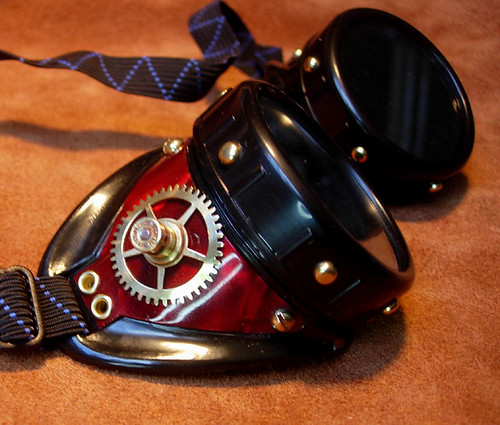
However, it seems to me that the prevalent interest in the broader Steampunk audience is more in style. As far as my eyes can tell, most Steampunk enthusiasts focus on sticking bits of gears onto just about anything, regardless of whether or not the gears serve any function. To me, that's sortof the opposite of what the Steampunk movement is about, I understand that gears, brass and leather all look great together, I love that look, but I think that it's an insult to steam machines to tack mechanical elements onto things for looks. Old steam machines are about the most efficient use of energy and material. I mean, look at THIS! Smooth fluid movement, not a part wasted, nothing aesthetic, just efficiency! That is what Steampunk is, a celebration of design, of human ingenuity, and top hats!
EDIT: At the request of a reader, I slapped together some picture of my preferences on steampunk! Check that out HERE.
Wednesday, June 8, 2011
Fixing School Libraries.
 I've spent a couple of days now over the last couple of weeks working with my mother at the library where she works. It's an elementary school library, which means that at the end of the year, most of the work she is doing is handling, cataloging, and storing textbooks. What I've realized while I was helping her is that the entire textbook system is completely ridiculous, and needs to be re-vamped. My brother has written on the subject of the broken education subject HERE, and while I agree that incorporating games into the curriculum is a great way to encourage students to learn, I think that starting with the books they are learning from is the way to go about fixing education. So, here I go.
Next week, Google is launching its Chromebook, a laptop based on the new Chrome OS. I've been using a Chromebook to update this blog since I started it, and today, it gave me an idea for a complete new infrastructure for books. The basic idea is that Chromebooks operate entirely in the cloud, using only the internet to do its work, rather than depending on built in storage space.
Every year, the library spends more than $200 per student on textbooks. Now, let's imagine that rather than spending that money every year, the school invested it into Chromebooks, which cost about $200 each. The laptops would be bar coded, inventoried, and checked out, exactly the same as the textbooks, but the secret is that the books would be designed specifically for the purpose of education. Every Chromebook is designed to link to a central server on campus, and on that server is the entire curriculum, every textbook is digitized, the workbooks are webpages, the homework comes in emails, and multiple choice grades itself. Students would keep their laptops through the course of the year, charging them in class, and if the teacher requires it, using their 8-hour battery overnight for homework time. The Chromebooks are designed with built-in 3G connectivity, which means that students who cannot afford internet at home could register for the 3G through the schools, so they could do homework.
Two years ago, the elementary school upgraded it's math curriculum, to the latest standards. (I'll talk about the quality of the standards another time) The school had to buy entirely new books for every student they had. If, however, they were using Chromebooks, all the curriculum update would take is the installation of new software on the central server, saving literally tons of paper every time the curriculum is updated. On top of that, the next year, the publisher told the school district that the math they had used for the year wasn't the right set, and sent them an entirely new set of papers! That's another ton of paper wasted, as well as more trouble for librarians! With Chromebooks, if there was a mistake like that, The solution would waste, at most a case of CDs, and at least, nothing, because the update could come over the internet, just like updates on any program on your computer.
A lot of people worry about students (especially elementary age) being on the internet. That's entirely reasonable, but the Chromebook can be developed to have network controls to keep students on a safe-network, so that the computer can only connect to the school's server. Or, pending parent sign-off, etc. the book could be allowed onto the full internet, or have various levels of parental control allowed.
Another interesting aspect of the Chromebooks is the centralized login. To log on to Chrome OS, you enter in your Gmail address and password, and all of your information is linked to that. For this system, the students (and teachers, staff, etc.) would each have a login account, which would store grades, homework, bookmarks (literal bookmarks in the e-books, for example) it could have links to a student's favorite educational games attached to the account, or a list of reminders on the home page for upcoming events, or homework. The real advantage of this is that without having to have the student's actual laptop, the parents or teacher of that student can look it up from literally anywhere that there is internet, regardless of whether or not they were using a Chromebook. Students could also use their home computers to do their homework, if one is available. On the other side of that coin, since every laptop is identical, and can all use the same accounts, if a student forgets (or "forgets") their Chromebook at home, the teacher can simply have a few spare laptops in the class. The students can log in and do their work anyway.
Now, I'm not saying that libraries should be abolished, or that all books should be burned, or anything silly like that. Rather, I'm suggesting that we ditch the business model of replacing books every two years, and only buy books that have a genuine lifespan. If we focused on a system that is built to last rather than being recycled (or sometimes thrown away) every two years, we can focus on the education, and not the money-making. The budget required for books would be cut in half (there would of course need to be some laptops replaced each year) and all of that money could be spent on other things, like after school programs, or art supplies. The Chromebook cloud computing system could make our schools more efficient, less expensive, and more fun for students, and who wouldn't want that?
Wednesday, March 16, 2011
Something inspirational

I have been listening to a song in Jen's car, a cover of "will you be there" by micheal jackson, and have been repeatedly irked by one of the lyrics.
But They Told Me
A Man Should Be Faithful
And Walk When Not Able
And Fight Till The End
But I'm Only Human
A Man Should Be Faithful
And Walk When Not Able
And Fight Till The End
But I'm Only Human
It's not the first time I've heard this excuse, and i doubt it's the first time you have. "I'm only human" I call bullshit. That's right, here and now, i want to silence anyone who has o ever intends to use their humanity as an excuse. Screw you. You're a disgrace to people.
"Oh snap!" I hear you say, "did he really just say that?" Of course I did. Being human is not something you can hide behind, it's something to be proud of. For thousands of years, people have been creating, loving, dancing singing, and being the greatest damn people on earth, all because they're human. Human beings are the only creatures on earth who think like we do, who really emote beyond basic instincts, is that something to hide behind? I say no, i'd say that it's a strength.
Take a short moment to look at the picture above. The reason i picked that building, the Aldar Hq in Abu Dhabi is that it strikes me as a beautiful symbol of us. Think for a moment about what must have gone into that building. Every single triangle of glass on the surface of that building is A: Gigantic, and B: has three side of different length. Think about that; Every triangle is different. Do you think that somehow, b random chance these thousands of triangles magically formed into a curved facade? Of course not! It was people, Humans, who took the work of honeybees, and applied their imagination to build skyscrapers, bridges, and homes. It's Humans whe launched themselves into space, who created medicine to help not only themselves, but other creatures as well/ Human isn't something to hide behind, it's something to be proud of.
Subscribe to:
Posts (Atom)